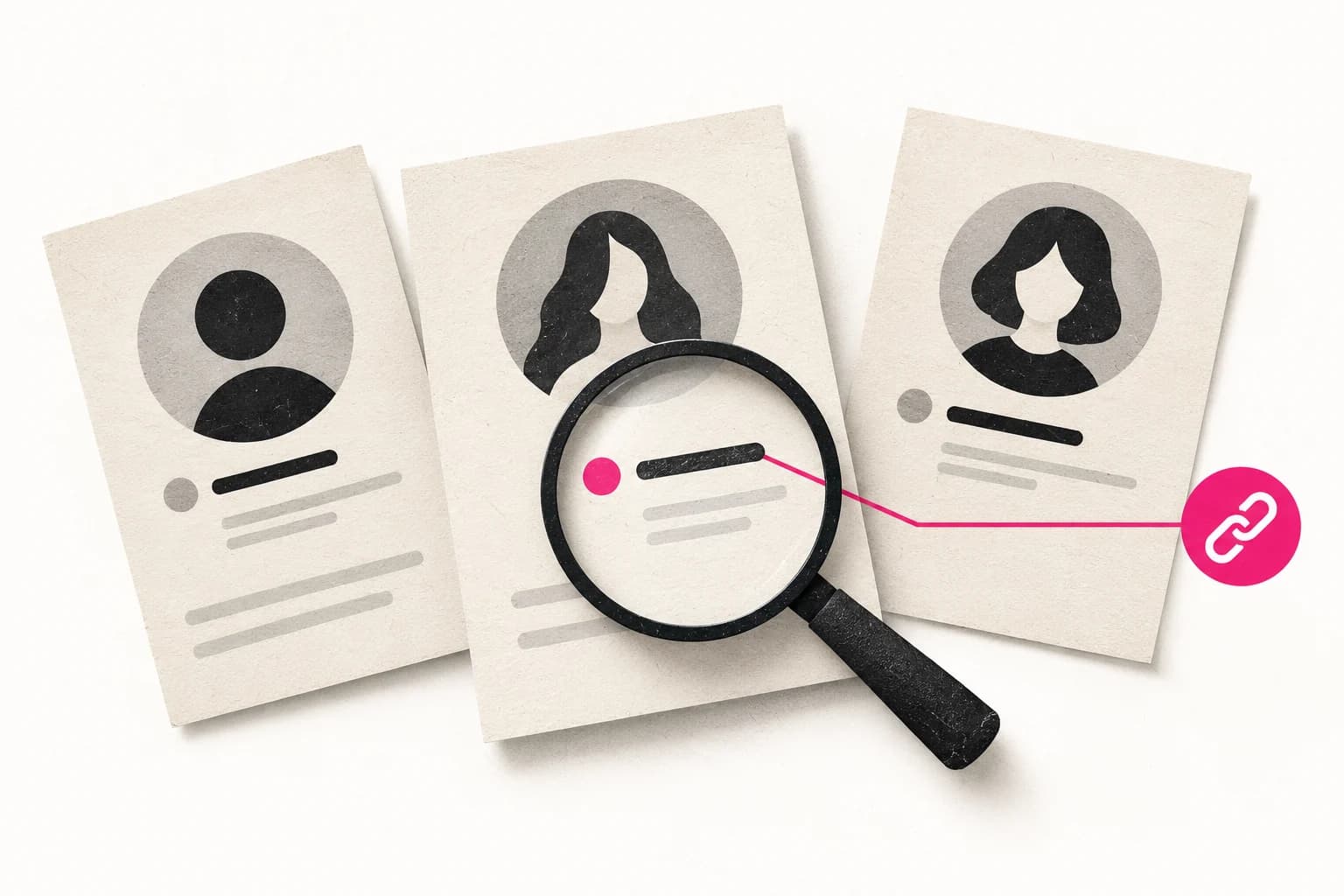
When two creator profiles use the same display name, compare their exact public destinations and the established channels linking to them. A name match is a reason to inspect a result, not a reason to merge the identities.
Use the public handle as a working identifier and the creator's own published links as supporting evidence. Do not try to settle the question by finding someone's private legal name.
Make two records before choosing one
Imagine a search for the fictional display name “Mara Studio” returns two different handles. Create a small comparison before following either account:
Scroll across the table on smaller screens.
| Check | Candidate A | Candidate B |
|---|---|---|
| Exact profile URL | Record it | Record it |
| Public channel that links here | Record the source | Record the source |
| Creator's stated subject or project | Copy the relevant meaning | Copy the relevant meaning |
| What still does not match | Keep visible | Keep visible |
This prevents a common error: taking the photograph from one result, the biography from another, and treating the combined details as one person.
OnlyDetect's public-data methodology keeps missing information unknown. A candidate with fewer details is not automatically the wrong person, but it may lack enough evidence for your decision.
Handle accents and alternate spellings carefully
A public name can have accents, spacing, punctuation, or a version written in another alphabet. Use variants the creator actually publishes. If you simplify a spelling to broaden a search, treat the resulting matches as a larger candidate set.
For example, removing an accent from a public name may produce more results. It does not establish that every unaccented match belongs to the same creator. A translated display name also does not guarantee that a Latin-script handle is a transliteration of it.
Search the original published spelling first, then one variant at a time. Avoid generating private email addresses or personal identity guesses from a name.
Prefer a connection over a visual match
An established creator website linking to a profile is stronger evidence than a familiar-looking avatar on an unconnected page. Photos, logos, and text can be reused.
The FTC's advice on phishing supports checking through a known route instead of trusting a link merely because its surrounding message looks familiar. The same habit is useful when a search result presents a convincing identity.
If neither candidate connects to the public creator you intended, keep both unconfirmed. There is no need to buy access to investigate the match.
Stop once the actual question is answered
Your question is which public page the creator has chosen to share. It is not whether you can uncover every account someone might operate.
For a confirmed handle, continue with official-link verification. If two pages are both publicly linked by the same creator, use the multiple-profile checklist to decide which offer matches your purpose.